



by Briar Brakhage

I was recently asked to do something I did not want to do. My therapist finished a session with these instructions: when I wake up in the morning, after brushing my teeth, I am to pause at the mirror, look myself in the eye, and breathe. Then, when I am ready, I am to raise my hand to the mirror—and give myself a high-five.
I immediately balked at the idea. What could this possibly do for me? He was quick to advise, reminding me that a high-five, in our culture, signifies praise and celebration. “You did it!” it says. The act of giving myself a high-five, he explained, develops neural pathways that allow me to see myself as successful and capable. It is a kind of rewiring of my mind. On a basic level, it’s practice. If I exercise these pathways and practice the skills of wellness, I develop the strength to realize my own abilities and cope with life’s stressors. In short, I develop faith in myself.
Faith and spiritual journeys have often eluded me. When a friend pointed out that the exercise from my therapist is a ritual intended to create spiritual growth, I winced—uncomfortable with the conflation of mental health counseling and spirituality. But the journeys of mental wellness and spirituality can—and do—run parallel, something understood by many for thousands of years.
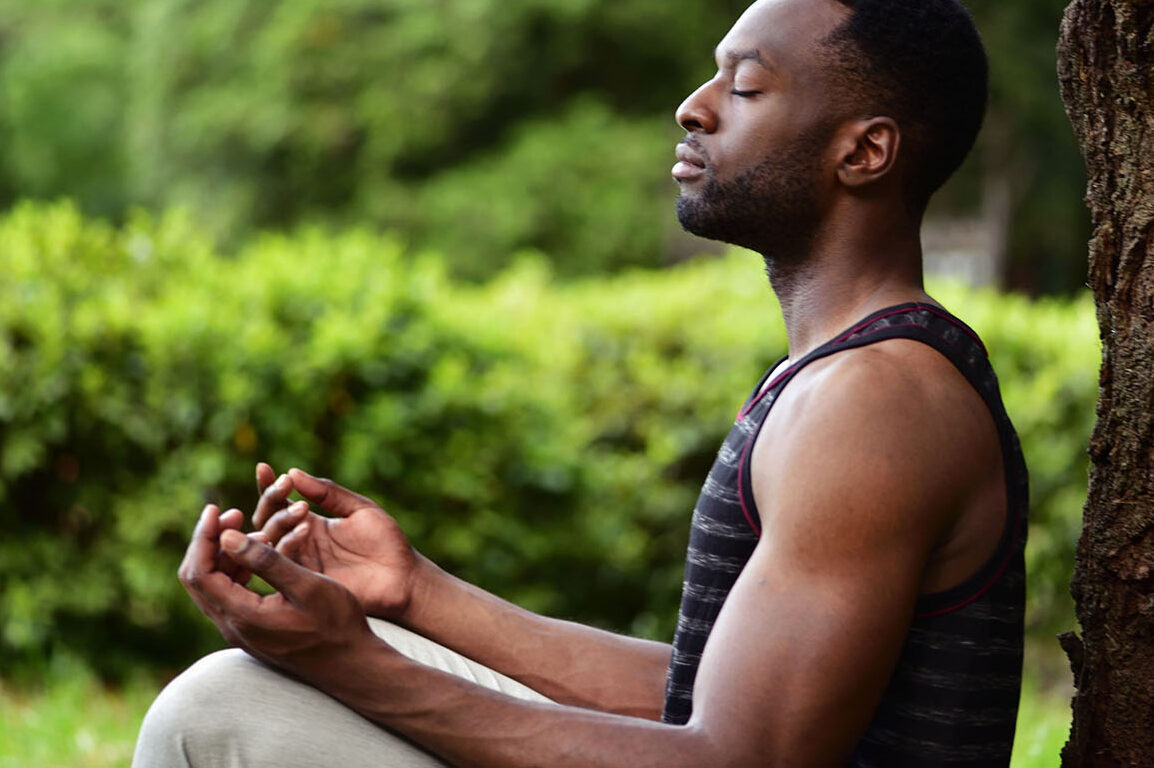
Consider yoga. “Yoga” is a Sanskrit word meaning “yoke” or “union,” and the intention of yoga is to unite the mind, body, soul, and universal consciousness. Though many of us take yoga classes to improve flexibility or work up a sweat, it is an ancient practice meant to treat much more. In the foundational text The Yoga Sutras, written around 200 B.C.E., Patanjali writes (translated from Sanskrit), “Yoga is the cessation of the whirling fluctuations of the mind.” Put another way, yoga relieves anxiety, soothes PTSD, and reduces symptoms of depression.
More than two thousand years later, researchers are proving Patanjali right. In the New York Times bestseller The Body Keeps the Score, Bessel van der Kolk, M.D., writes of his research on PTSD and yoga. He found that people with PTSD have low heart rate variability—an issue of the nervous system that negatively affects thinking, feeling, and how the body responds to stress. He sought to understand the relationship between heart rate variability and yoga. His findings were clear: eight weeks of yoga significantly improves heart rate variability in people with PTSD, as well as improving the subjects’ relationships to their bodies. With improved heart rate variability, their biological systems become more capable of responding to stressors.
While much of the yoga taught and practiced in the West focuses on the physical body—emphasizing poses, breathing exercises, relaxation, and fitness—practicing from a spiritual outlook can bring greater depth and meaning to yoga. In this way, the goals shift from the body to the spirit, with the ultimate purpose being an awakening of the true self and a realization of our highest potential. Personally, I have spent a lot of time in many therapists’ offices searching for exactly what spirituality invites me to find on a yoga mat.
Spirituality is a vague concept, but we can think of it broadly as a search for or belief in something sacred and beyond the material world. We can measure the physiological benefits of yoga all day. Numerous empirical studies confirm that yoga is good for mental wellness, with positive effects on mindfulness, happiness, resilience, self-compassion, and more. It also helps treat various psychological and psychiatric conditions such as depression, anxiety, fatigue, and eating disorders. Interestingly, many of those studies include comments on outcomes that are harder to quantify: a sense of safety in one’s own body, a sense of oneness and peace, a sense of wisdom and clarity.
Practices like yoga can objectively improve mental wellness, but the goals of yoga are not merely to improve today’s mood. By turning the focus inward, the improvements have the potential to be transformative.
While yoga is often practiced individually, the power of touch is another way to develop a sense of safety within one’s own body. As van der Kolk explains, “The most natural way that we humans calm down our distress is by being touched, hugged, and rocked, [which] makes us feel intact, safe, protected, and in charge.”
Many studies have found that massage positively affects anxiety, depression, and stress. It is known to lower heart rate and cortisol levels and release serotonin. Massage can be far more than pampering and relaxation. Like yoga, we now have scientific evidence of its real and measurable benefits for mental wellness. And just like yoga, before the science, we had millennia of wisdom.
Consider some of the ancient healing traditions: Ayurveda, Qi Gong, and Reiki. These are energy-based systems that include a belief in a life-giving energy within all of us. When that energy is out of balance or blocked, we feel pain, distress, or struggle. These traditions are vast and complex, but all acknowledge the healing power of laying hands on someone—the ability to lessen pain through connection.
Even the stories of Jesus Christ speak of the healing power of touch. Cortisol and serotonin are powerful, but so is the spiritual connection available in a healing massage. This connection can be present anytime a practitioner sees someone’s pain and pours loving, nurturing, and healing energy into that space.
When examining that connection, we can acknowledge the mechanics—applying pressure and heat, triggering chemical effects in the brain and nervous system—all of which are real and beneficial. But if we also allow ourselves to acknowledge the intangible healing available—the sense of unity and togetherness, the feeling of being loved, and even the connection to a greater consciousness—we can do more than manage our mental health. By allowing the paths to run parallel, we unlock the transformative power of spiritual growth.
I believe my therapist when he talks of repairing neural pathways by high-fiving my reflection. I understand what we are correcting, psychologically. But when I stand before my mirror, focused and centered, seeing myself in a way I’ve avoided so many times before—raising my hand to connect with my reflection, smiling at the gesture in spite of myself—I can see this ritual for what it is: a threshold to a deeper connection with myself than I ever imagined, an invitation to wholeness, and a call toward the greater consciousness of the universe.
I might be starting with neural pathways, but the paths beyond are divine.

