



Part One of Three | Focus investigative series by Ray Rico
Dr. Johnnie LaDue: A Professor Pushed Out
Dr. Johnnie LaDue spent years teaching students how to question information and evaluate evidence. After complaints about her use of the women’s restroom, UT Martin ended her career in a matter of weeks.
On September 15, 2026, Dr. Johnnie LaDue returned to work at the University of Tennessee at Martin after a four-day weekend and began using the women’s restroom as her primary restroom during the workday.
Two days later, she was warned to stop.
Eight days after returning to campus, she was placed on administrative leave. She would never return to her workplace.
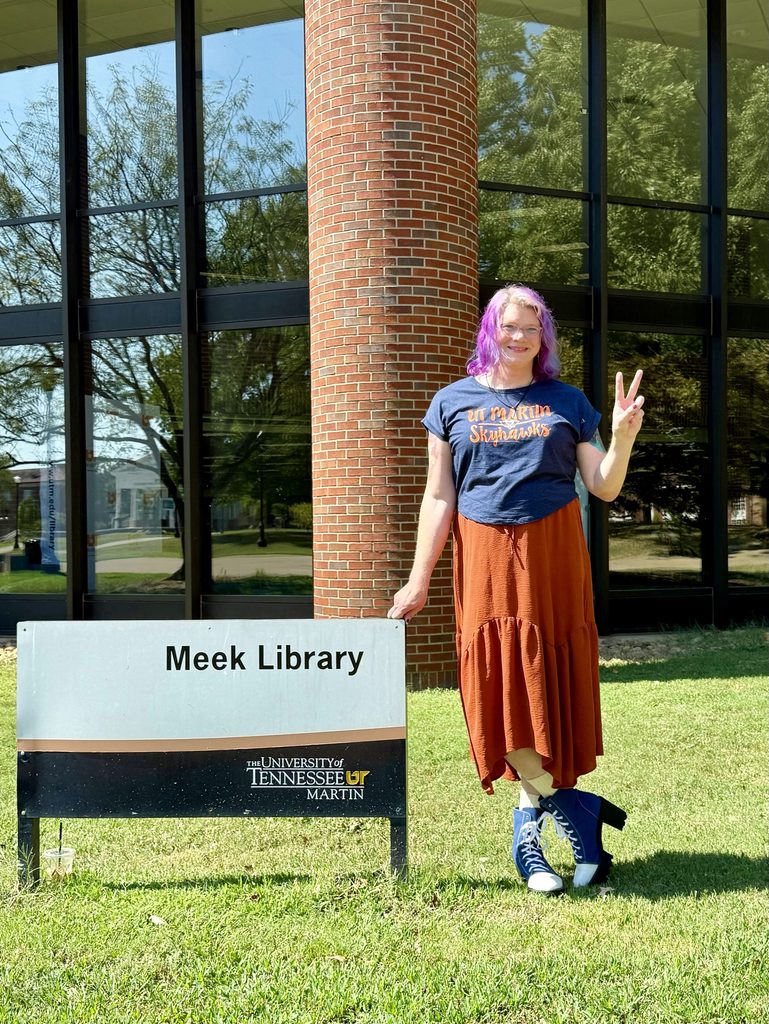
On October 13, UT Martin terminated her employment as an assistant professor and information literacy librarian, ending a university career that had included published research, student mentorship, faculty committee service and recognition for her work with the campus community.
For LaDue, a transgender woman who had begun living openly as a woman at work in 2025, the consequences extended far beyond losing a job.
She has since left Tennessee, relocated to Michigan with her dogs, and begun reconsidering whether she wants to work in higher education again.
The university’s decision also raises questions that reach beyond one employee. How did a restroom complaint become grounds for terminating a faculty member? What alternatives did administrators consider? And what does the case mean for transgender people who teach, study and work at Tennessee’s public universities?
Documents reviewed by Focus, interviews with LaDue and accounts from people familiar with the situation offer a detailed picture of how quickly the dispute unfolded.
An educator with a record of service
Before the termination, LaDue’s professional life centered on helping people understand information.

At UT Martin’s Paul Meek Library, her responsibilities included teaching research skills, helping students evaluate sources, developing instructional materials and supporting faculty members who wanted to strengthen research instruction in their courses.
Her work took her beyond the library.

In February 2025, UT Martin’s Department of Mass Media and Strategic Communication publicly thanked LaDue for visiting a communication research class. She helped students understand secondary research and the effective use of artificial intelligence in their research process.
In December 2024, the university’s library promoted her public presentation on corporate control of American media, part of a research series examining issues affecting society and public understanding.
Her scholarly work had also earned recognition. In October 2024, UT Martin announced that her paper, Information Literacy: Moving Beyond Critical to Revolutionary, had received an honorable mention in the annual Library Juice Paper Contest. The paper appeared in the Journal for Critical Education Policy Studies.
Her academic background included a doctorate in education and a master’s degree in library and information science from the University of Pittsburgh. Before arriving at UT Martin in 2022, she had spent years working with educational technology and information resources.
LaDue’s work also connected her with students outside traditional academic settings.

In April 2025, a campus organization recognized her with the Elliot McKeel Advocate and Ally Award, praising her volunteer work and involvement in student activities.
University-affiliated accounts also documented her participation in a Women and Gender Studies Summer Seminar in August 2025 and a Transgender Day of Remembrance gathering later that year.

These examples do not settle the questions surrounding her dismissal. They do, however, establish that LaDue’s relationship with the university was more extensive than the disciplinary dispute that ended her employment.
Finding her place on campus
LaDue said many of her colleagues responded positively when she began living openly as a woman.
“Many of my colleagues were, and still are, very supportive of me and my transition,” she told Focus.
She recalled that colleagues selected her to represent the library on a committee involved in the search for a new provost. She also said she received a favorable mid-tenure review, although she no longer has immediate access to that paperwork.
There were smaller moments that mattered, too.
LaDue said the library dean checked on her several times to ask whether she was experiencing harassment. She recalled that she generally was not.
But she also noticed changes.


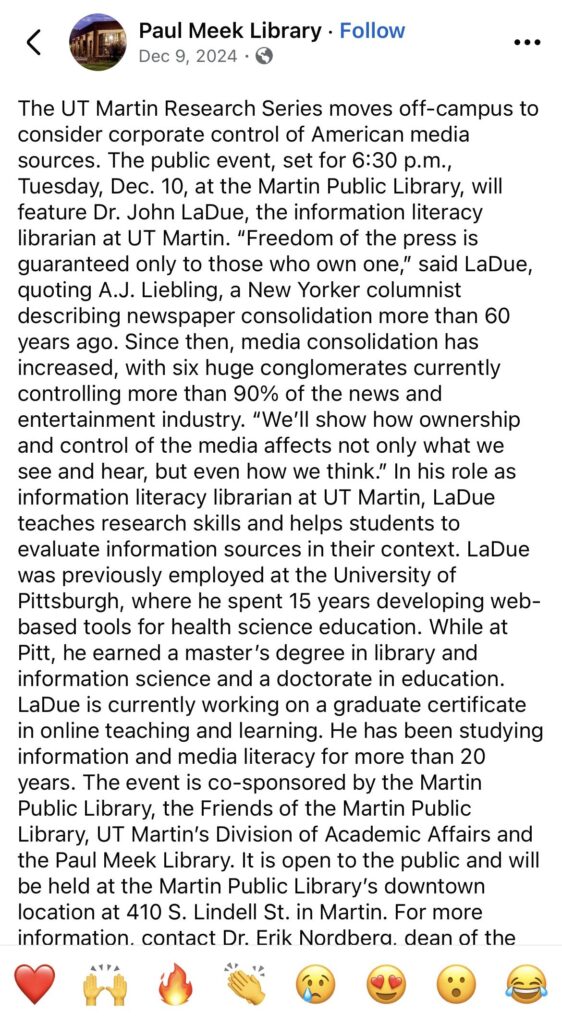
She believed her appearances in the library’s social media coverage became less frequent after she came out. That observation reflects her experience, rather than a verified institutional decision to exclude her.
Before September, LaDue said she had generally used a single-occupancy restroom near the staff breakroom. She found the arrangement uncomfortable because of its location and lack of privacy.
After returning from a vacation where she felt consistently recognized as a woman, she decided to begin using the women’s restroom during the regular workday.
For the first few days, she said, nothing seemed unusual.
She recalled ordinary conversations with coworkers in the restroom.
Then came the complaints.
Eight days that changed everything
LaDue provided Focus with a detailed account of the disciplinary timeline.
September 15: She began using the women’s restroom as her primary restroom during the regular workday. She said she had previously used it occasionally during late shifts.
September 17: LaDue said she received notice of a complaint and a verbal warning. Administrators directed her to use either the men’s restroom or a single-occupancy facility.
September 21: After another reported complaint, she received a written warning. She was again instructed to use one of the alternative facilities and told that further disciplinary action, including termination, could follow.
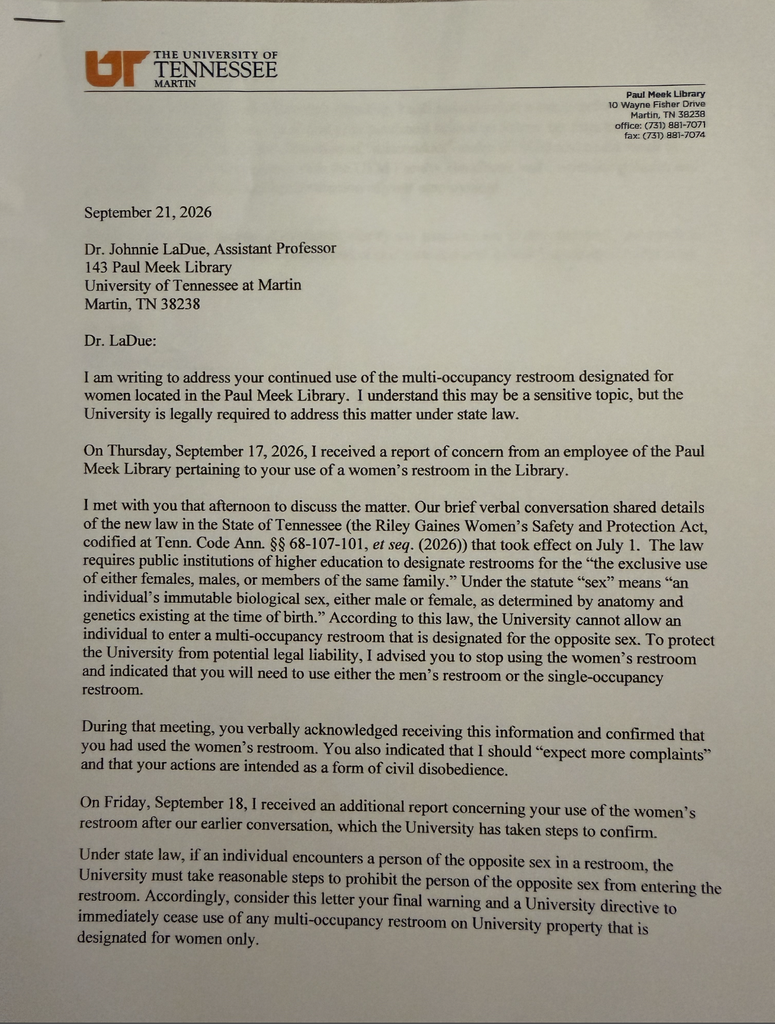
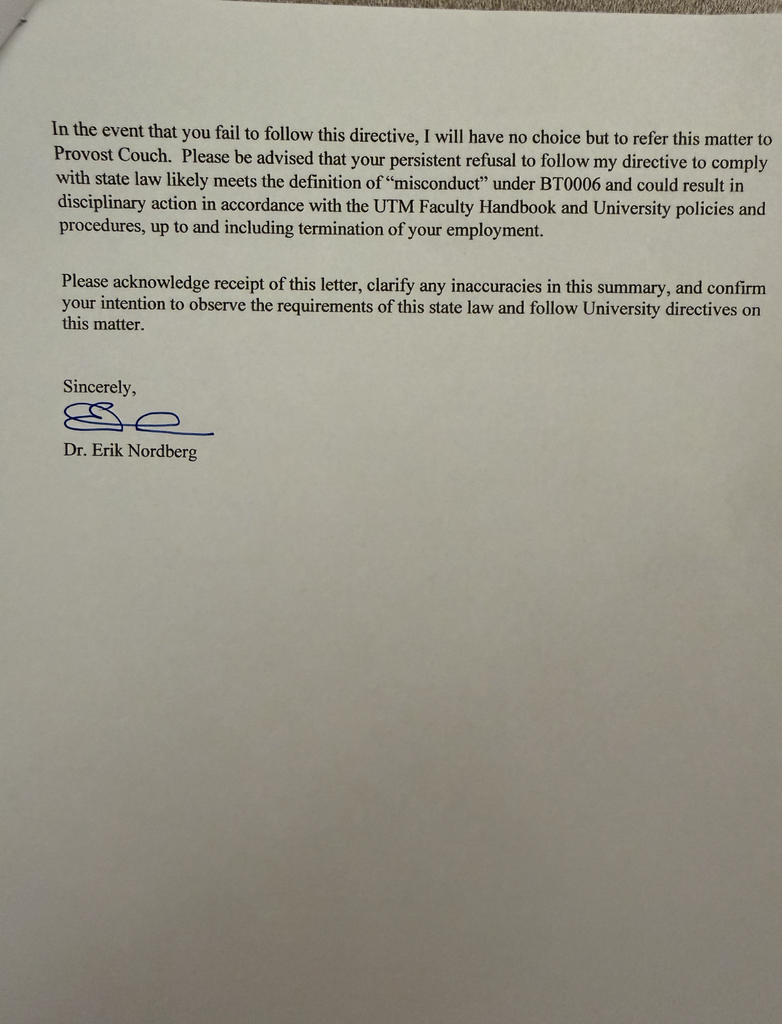
September 23: LaDue said Provost Laurie Couch informed her of another complaint and placed her on administrative leave.
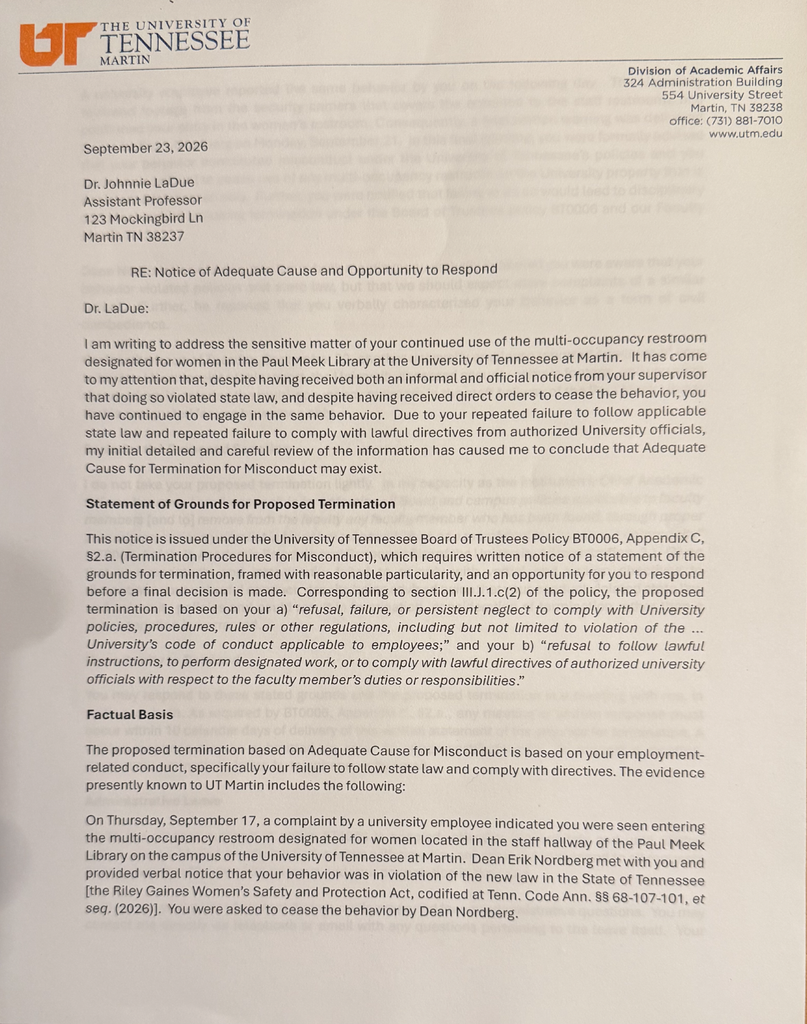
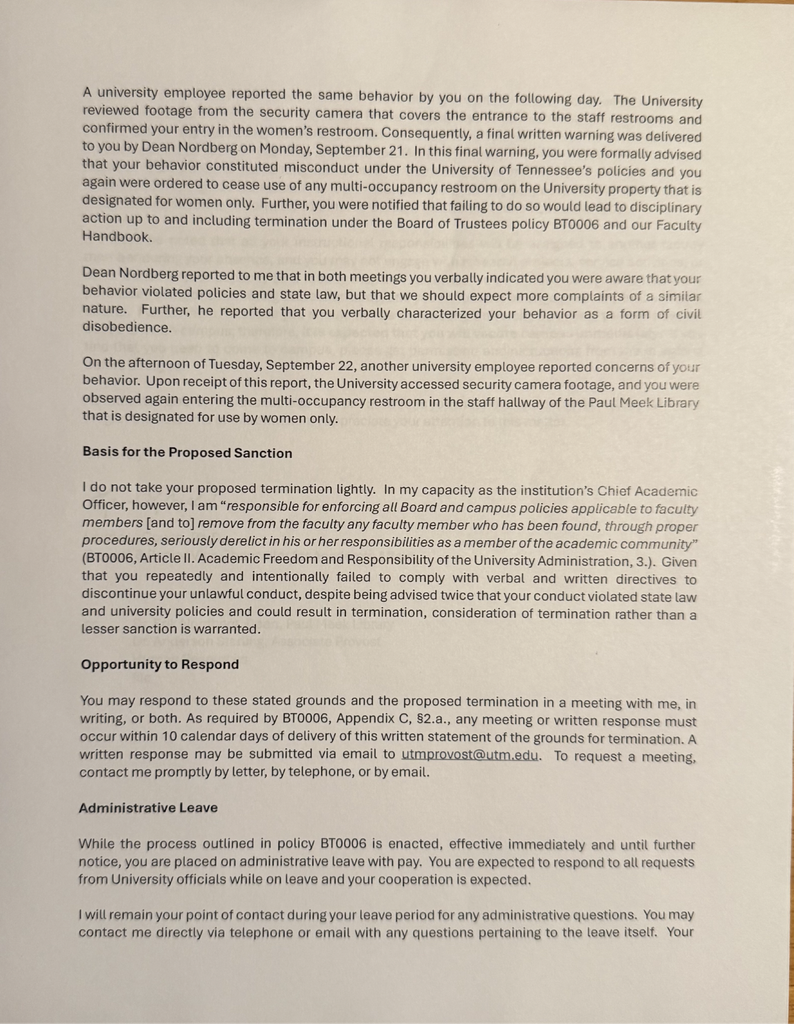
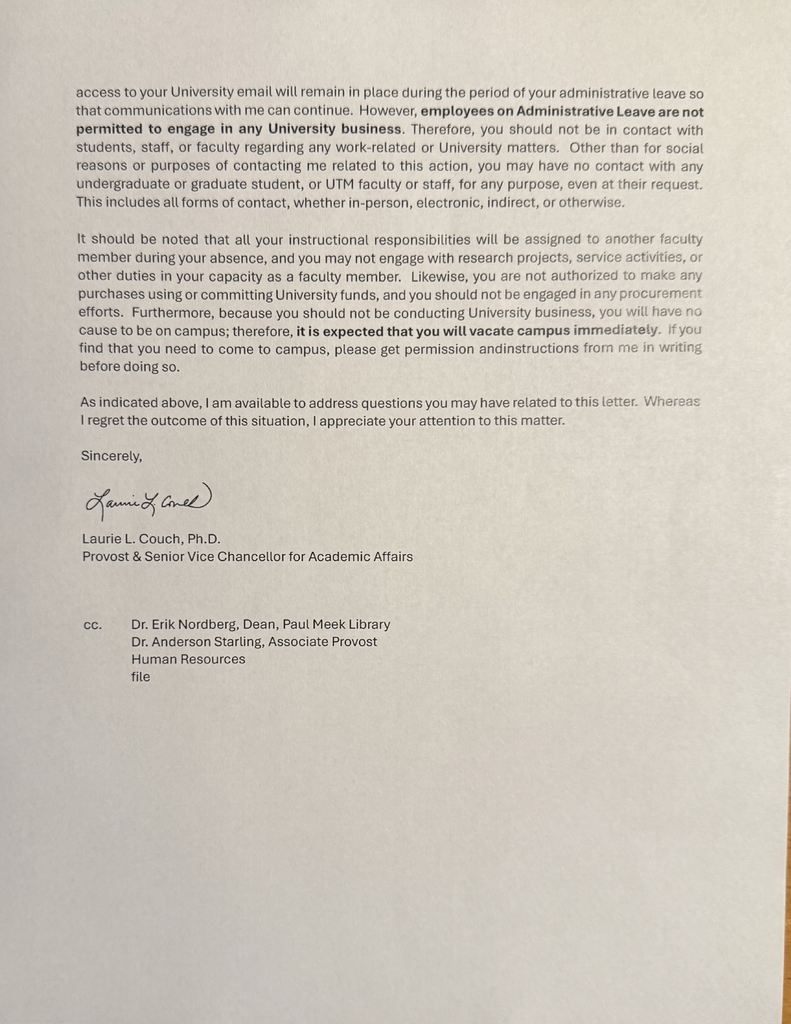
September 28: LaDue submitted a written response disputing the grounds for proposed termination.
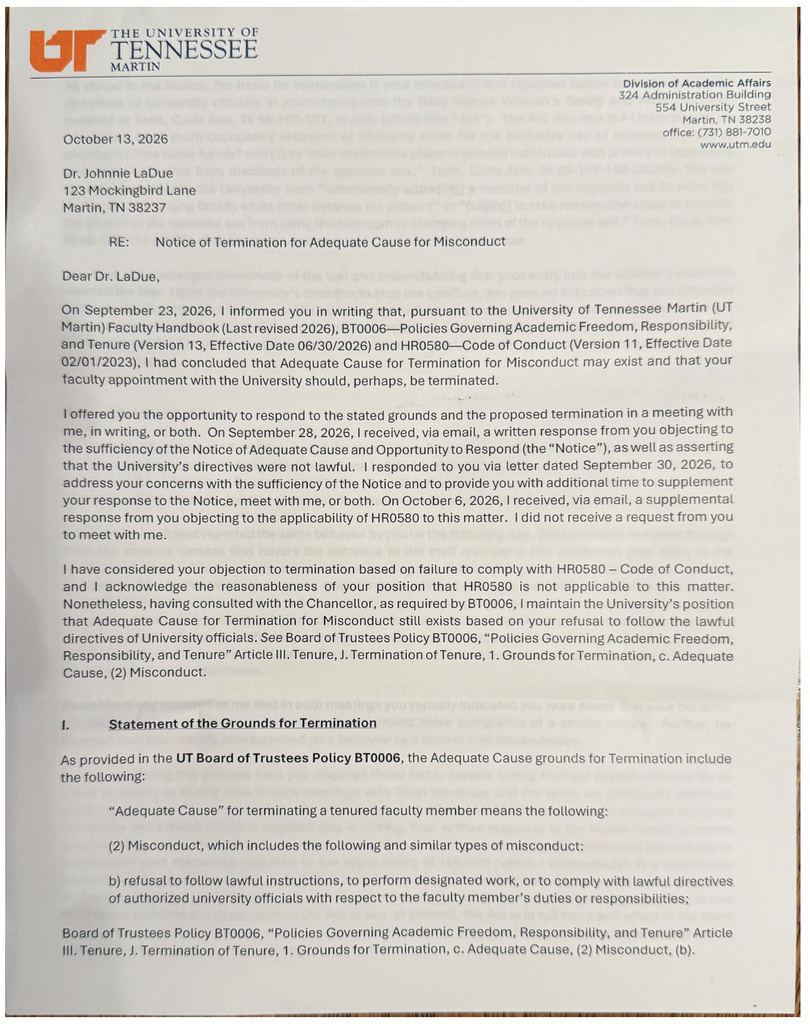
October 6: She submitted an additional response challenging the university’s reliance on a particular personnel policy.
October 13: UT Martin terminated her employment.
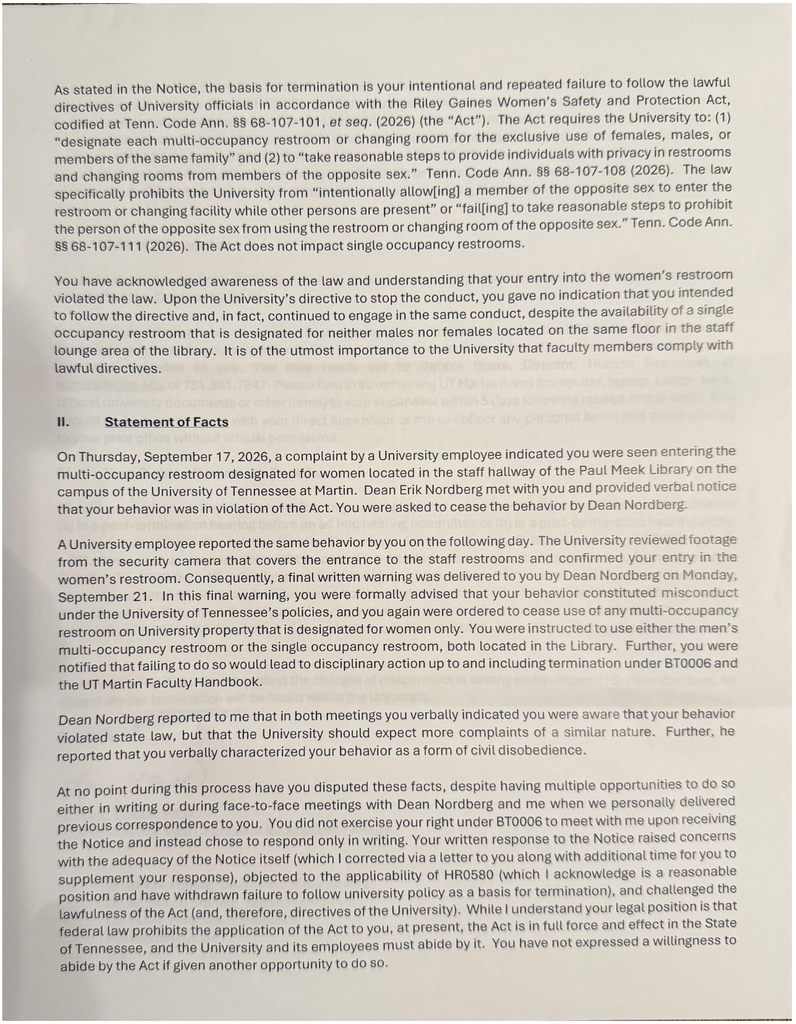
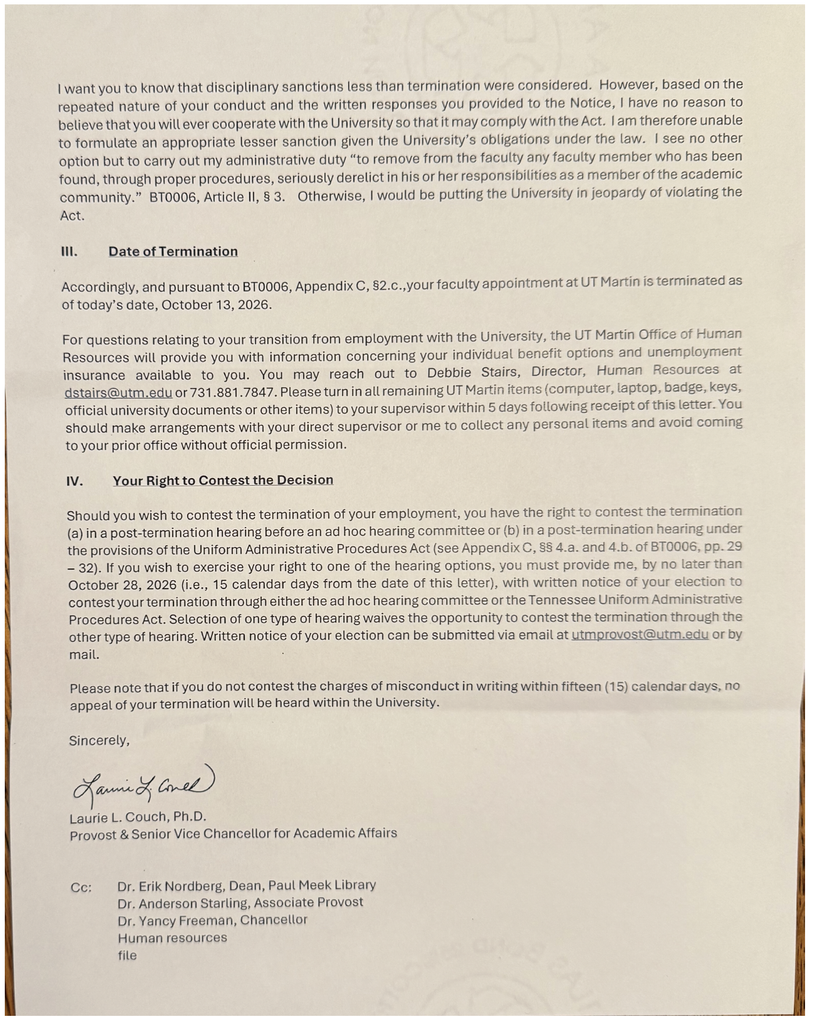
LaDue said she was never shown the complaints themselves.
She also said she was not told whether the complaints came from one person or several people.
According to LaDue, administrators told her they had reviewed security camera footage to verify the reported restroom use.
Her account raises questions about what information was available to her during the disciplinary process and how the university evaluated the complaints.
NOTE: These letters were provided by Dr. Johnnie LaDue and used with permission.
A dispute over compliance
The university’s disciplinary correspondence connected the dispute to Tennessee’s Riley Gaines Women’s Safety and Protection Act, which took effect July 1, 2026.
The legislation establishes requirements concerning access to sex-designated facilities, including multi-occupancy restrooms, at covered institutions.
But the legal requirements imposed on universities and the disciplinary consequences imposed on individual employees are separate questions.
In its correspondence, UT Martin instructed LaDue to comply with restroom restrictions. LaDue maintained that the directive conflicted with her federal rights.
She challenged the university’s interpretation in writing before her termination.
Her responses raised questions under Title VII of the Civil Rights Act, the Equal Protection Clause of the Fourteenth Amendment and the First Amendment.
Those arguments are disputed legal positions, not findings by a court.
The university’s October 13 termination correspondence also addressed LaDue’s objection to the applicability of personnel policy HR0580. According to the correspondence described to Focus, the university acknowledged that her objection to the cited provision was reasonable, while maintaining its decision to terminate her for failing to follow directives.
The distinction matters.
If a state law requires a university to regulate restroom access, it does not automatically follow that the law requires termination of an employee who does not comply. Whether UT Martin had discretion, and whether its decision complied with federal law, are central questions examined in the second installment of this series.
A university declines to discuss the case
Focus contacted UT Martin and the University of Tennessee System seeking answers about the termination, the university’s interpretation of the law, the policies used to discipline employees and whether alternatives to termination were considered.
Melissa Tindell, vice president of communications and marketing for the UT System, responded:
“The university does not provide comment on personnel matters.”
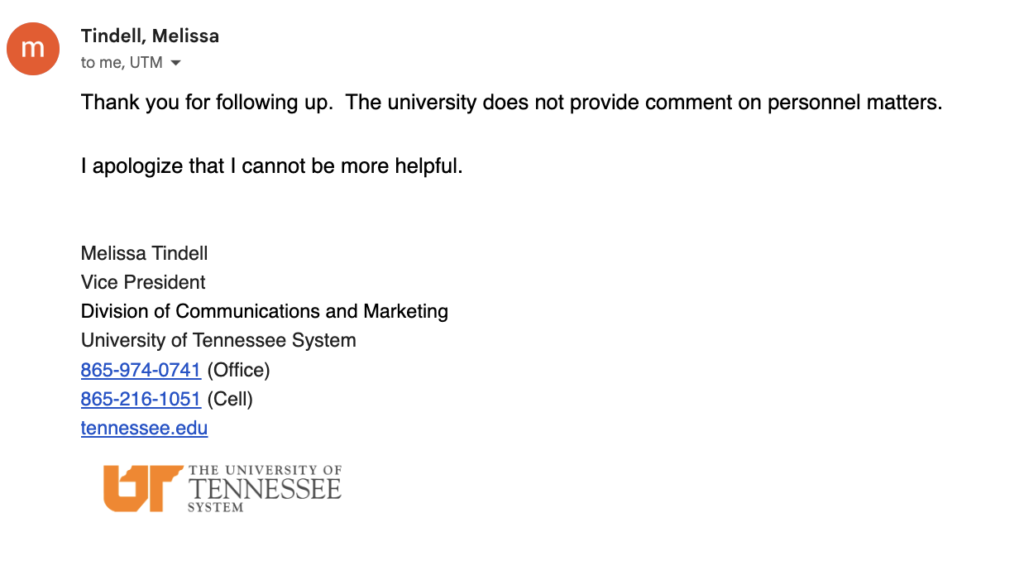
Focus also requested clarification about enforcement of restroom rules.
The response provided does not address the specific questions about the university’s interpretation of the law or its choice of disciplinary action.
The absence of a detailed public explanation leaves the university’s correspondence as the principal documented account of its reasoning available for this report.
Support from colleagues
Not everyone at UT Martin agreed with the decision.
A public statement circulated by United Campus Workers at UT Martin condemned the termination and expressed support for LaDue.
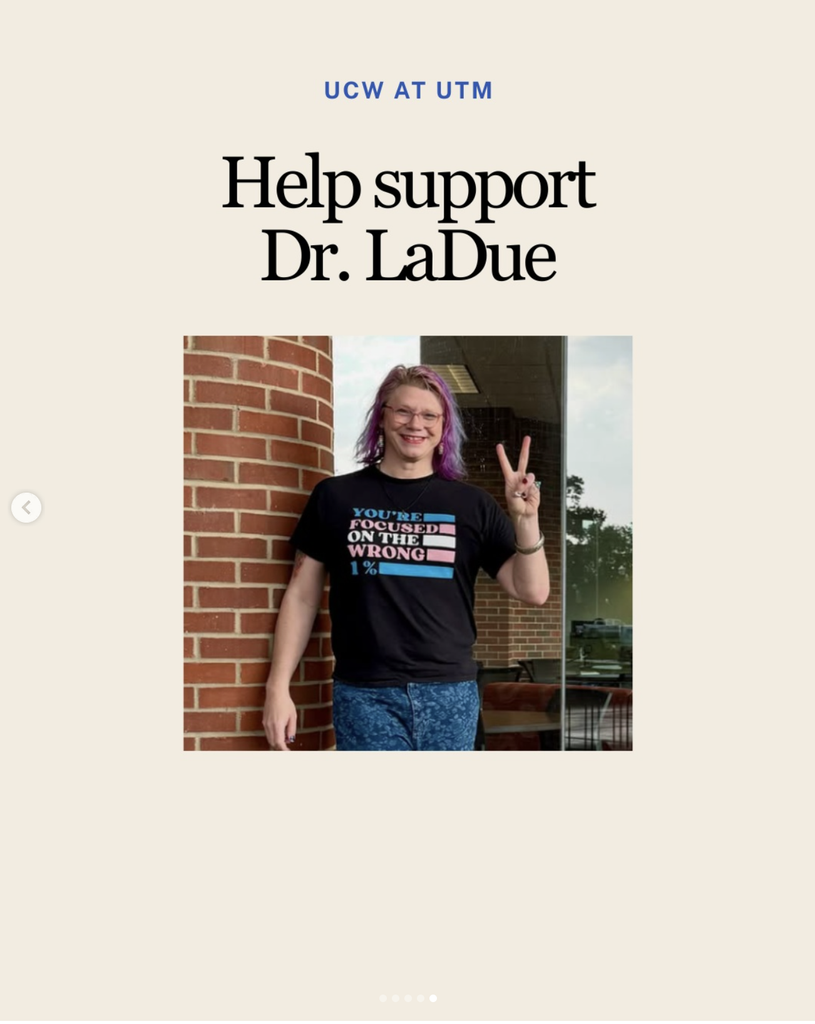
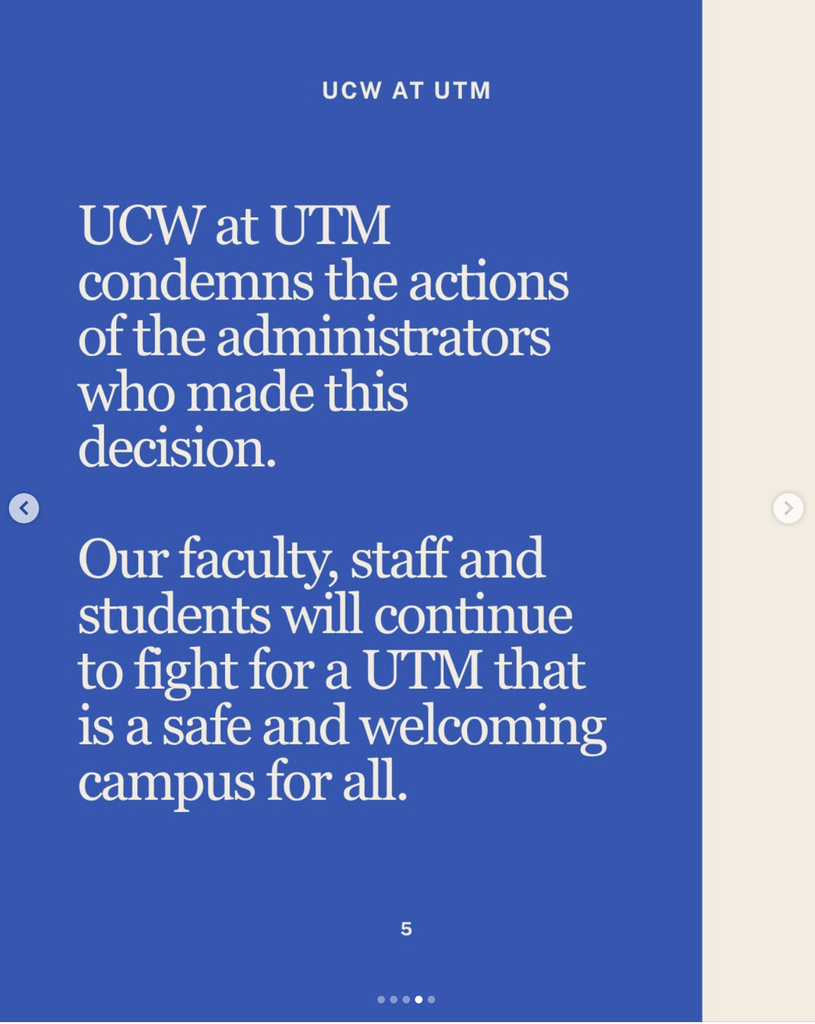
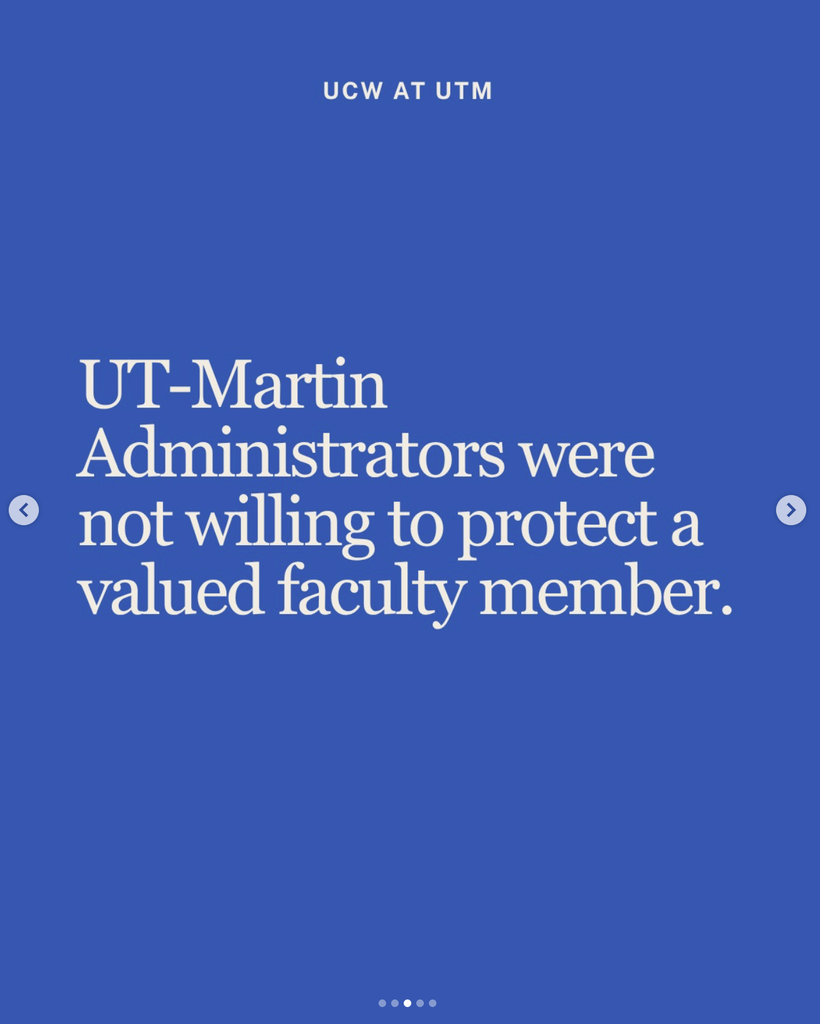
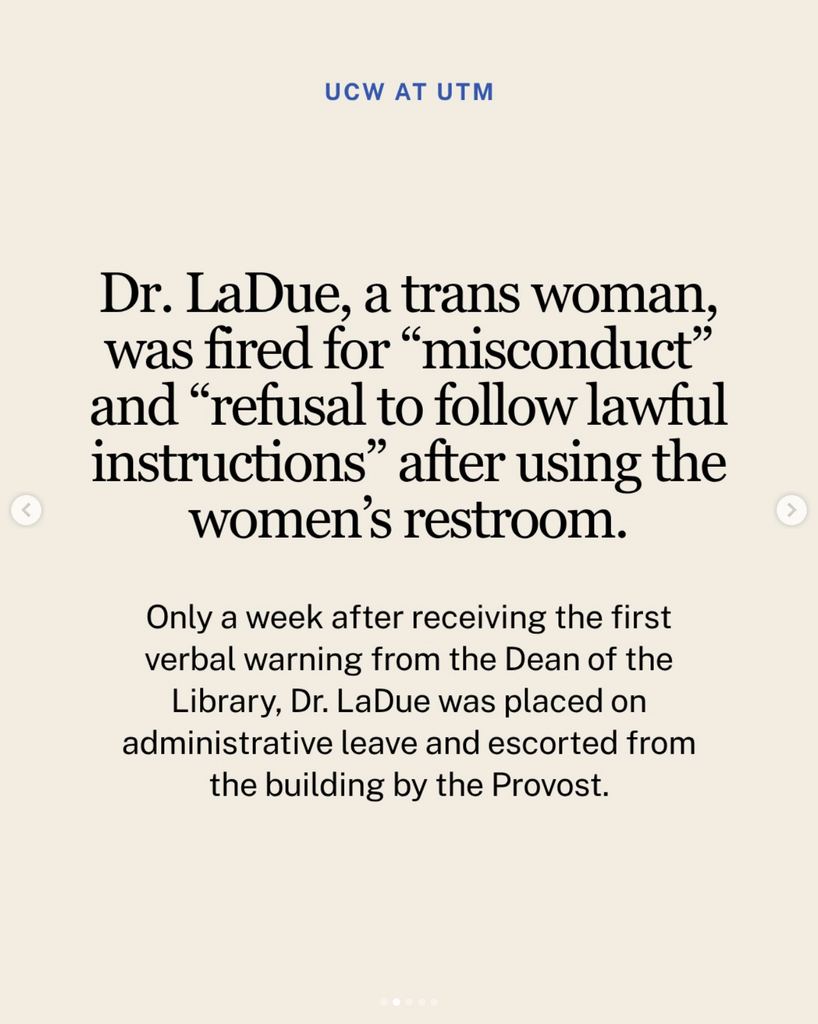
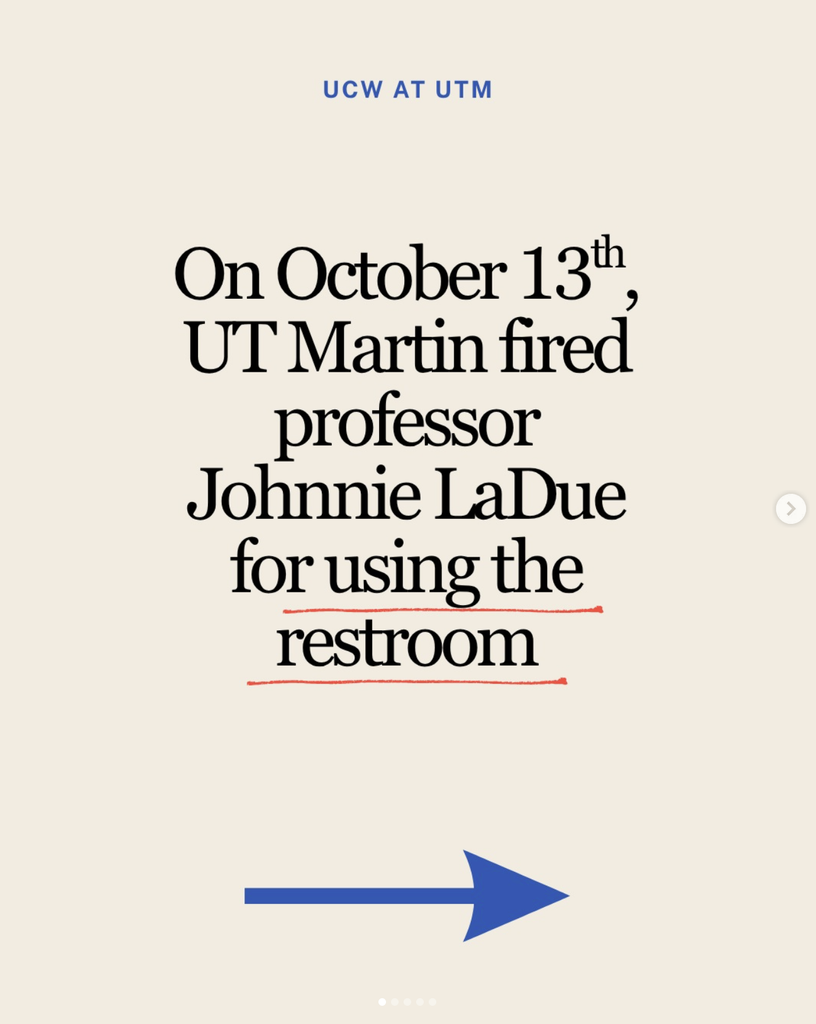
The statement characterized her dismissal as a failure to protect a valued faculty member and pledged continued efforts toward a campus welcoming to all.
People familiar with the situation also described concerns about the effect of LaDue’s departure on students and other employees.
A source close to the story described her work providing research instruction tailored to individual courses and expressed concern that her sudden departure would leave instructional responsibilities uncovered or redistributed.
That concern is consistent with the responsibilities described in LaDue’s professional record, although Focus has not independently established whether the university has permanently reassigned her duties or plans to replace her position.
The same source described anxiety among some faculty members about speaking publicly on sensitive university decisions.
Those accounts suggest that the consequences of the termination may extend beyond LaDue herself, particularly for employees who are uncertain about how campus policies will be applied.
UT Martin’s school paper, The Pacer, also reported on the story just days ago.
Starting over in Michigan
By the time LaDue spoke with Focus about the personal consequences, she had relocated to a short-term rental near Detroit.

She moved with her dogs and without an established local support network.
Affordability was a major factor in choosing the city.
The move followed an abrupt end to her university employment and the prospect of substantial financial uncertainty.
LaDue said she was preparing to sell her Tennessee home and withdraw retirement savings to help cover expenses. She also faced the loss of employer-provided health insurance at the end of November unless she secured new coverage.
A GoFundMe fundraiser has been established in connection with her relocation and employment loss.
The professional consequences may be harder to calculate.
Information literacy and academic library instruction are specialized fields. LaDue said suitable positions are limited, particularly in places where she would feel safer living openly as a transgender woman.
She is also questioning whether she wants to return to higher education.
“I’m also not sure if I want to continue in higher ed,” she told Focus.
The uncertainty is particularly significant for someone whose professional record reflects years of investment in teaching, research and student support.
LaDue said she appreciates the colleagues who have remained supportive. At the same time, she has been disappointed by the silence of others.
Her future remains unsettled.
Why she did not appeal
The October 13 termination letter identified an October 28 deadline for an internal appeal.
LaDue did not file one or request a hearing.
She explained that the appeal would have remained within the university system and that she did not believe administrators were likely to reconsider their position.
She described the process as seeming like a pointless endeavor.
That decision should not be mistaken for agreement with the termination.
LaDue had already challenged the university’s reasoning in two written responses. Those responses disputed the legal basis for the directives and the university policies cited during the process.
The question of whether the available procedures provided meaningful opportunities for faculty members to contest disciplinary action remains relevant to the broader investigation.
What happens next?
LaDue’s termination has become more than a dispute over access to a restroom.
It is now part of a larger discussion about the relationship between state legislation, federal civil rights protections, university authority and the ability of transgender faculty members to work without discrimination.
Her story also raises questions about what a university loses when it suddenly removes a faculty member with years of specialized experience.
A professional record documents the educator LaDue was before September 2026.
University letters document the disciplinary process that followed.
And there is a woman now rebuilding her life hundreds of miles from the campus where she once taught students to examine evidence and ask difficult questions.
Those questions have become central to her own story.
Next in the series: Did Tennessee Law Require Her Firing? Focus examines the state law, UT Martin’s disciplinary correspondence and the federal legal questions surrounding Dr. LaDue’s termination.
Editorial note: Historical university posts may use LaDue’s former name or pronouns. Focus uses Dr. Johnnie LaDue and she/her pronouns throughout.

