



Part Two of Three | Focus investigative series by Ray Rico
Did Tennessee Law Require Firing Dr. Johnnie LaDue?
UT Martin says Dr. Johnnie LaDue was terminated for refusing to follow directives under a new Tennessee restroom law. But the law, the university’s changing explanations and federal civil rights protections raise a larger question: Did administrators have another choice?
When the University of Tennessee at Martin fired Dr. Johnnie LaDue on October 13, 2026, the university had already warned her, removed her from campus and considered her written objections to the disciplinary process.

The dispute began with complaints about a transgender professor using the women’s restroom.
It ended with the loss of her job.
But one question remains at the center of the case: Did Tennessee law actually require the university to terminate her?
The distinction is important because Tennessee’s Riley Gaines Women’s Safety and Protection Act establishes requirements for sex-designated facilities at public universities. It does not expressly direct universities to fire employees who violate restroom restrictions.
Documents reviewed by Focus show that UT Martin initially raised concerns involving university policy before ultimately grounding its termination decision in LaDue’s refusal to follow directives connected to the state law.
LaDue disputed those directives before she was fired. She argued that enforcing the law against her violated federal employment and constitutional protections.
The university proceeded with termination.
Now, according to information obtained by Focus about the case’s legal status, federal claims are being prepared on LaDue’s behalf.
The dispute presents a potentially significant test of how Tennessee’s restroom restrictions interact with federal civil rights protections for transgender employees.
What Tennessee’s law actually says

The Riley Gaines Women’s Safety and Protection Act was enacted in 2026 as Public Chapter 1052, following passage of Senate Bill 468 and House Bill 571.
The legislation took effect July 1, 2026, less than three months before the complaints involving LaDue.
Among its provisions, the law requires covered public institutions of higher education to designate multi-occupancy restrooms, changing rooms and sleeping quarters for use according to specified sex classifications.
It also requires institutions to take reasonable steps to provide privacy in those facilities.
Those requirements establish obligations for covered institutions.
They do not, on their face, prescribe termination as the required disciplinary response to an employee’s noncompliance.
That does not necessarily mean a university lacks authority to discipline an employee for refusing an instruction it considers lawful. It means the source of that disciplinary authority, and the limits imposed by federal law, must be examined separately.
For LaDue, the distinction is fundamental.
She did not dispute that administrators instructed her to stop using the women’s restroom.
She disputed whether they could lawfully require her to do so.
From restroom complaints to termination
According to LaDue, she began regularly using the women’s restroom during the workday on September 15.
On September 17, she received notice of a complaint and a verbal warning.
Administrators directed her to use either the men’s restroom or a single-occupancy restroom.
A second warning followed on September 21.
On September 23, LaDue said she was informed of another complaint and placed on administrative leave.
She was not allowed to return to campus.
LaDue told Focus that she was never shown the complaints and was not told how many people had raised concerns.
She said university officials told her they had checked security camera footage to verify the reported restroom use.

The university’s position, as reflected in the disciplinary correspondence described to Focus, was that LaDue had repeatedly failed to follow instructions concerning restroom use.
LaDue’s position was that those instructions were unlawful.
The distinction between refusing a lawful employment directive and objecting to a discriminatory directive is one of the central issues in the case.
The university’s changing explanation
The disciplinary record reveals another important development.
LaDue challenged the university’s reasoning in writing on September 28, arguing that the notice she received did not identify a specific university policy she had violated.
The university subsequently relied on HR0580, the University of Tennessee System’s Code of Conduct.
HR0580 establishes broad expectations for ethical and responsible workplace conduct. It addresses subjects including professional behavior, confidentiality, conflicts of interest, appropriate use of resources and compliance with applicable laws.
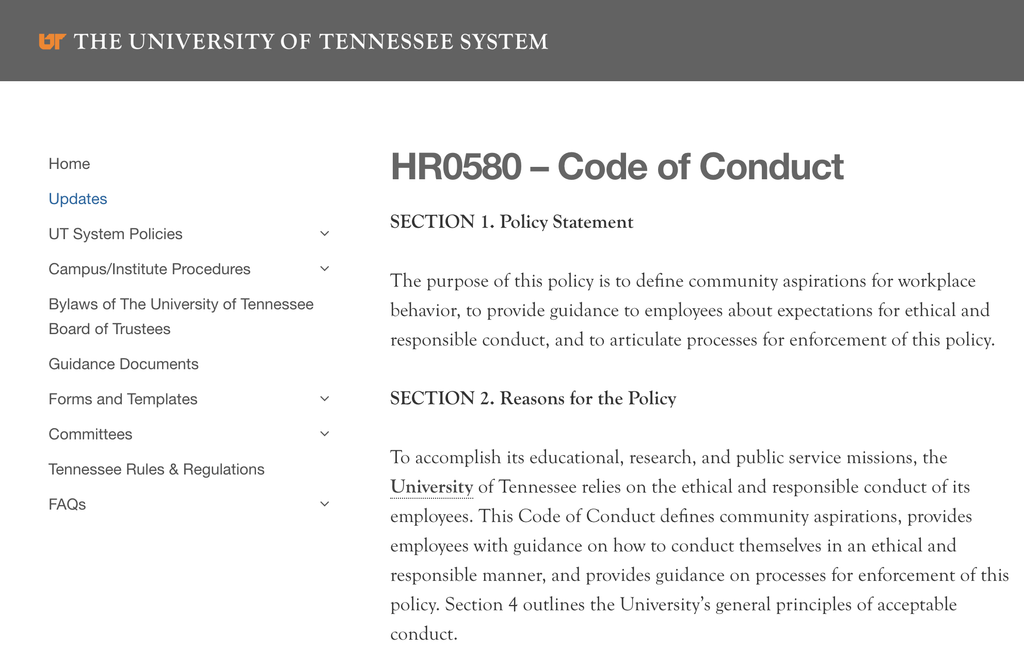
It also allows disciplinary action for noncompliance.
But the specific provision cited during LaDue’s disciplinary process became a point of disagreement.
In her supplemental response, submitted October 6, LaDue argued that the provision did not apply to restroom access. She also challenged the university’s reliance on an accompanying guidance document.
According to the October 13 termination correspondence described to Focus, the university acknowledged the reasonableness of her objection to that particular policy provision and did not maintain the alleged HR0580 violation as an independent basis for dismissal.
Instead, the termination rested on her repeated refusal to follow directives connected to the Riley Gaines Act.
That development narrows the dispute.
It places the legality of the university’s directives, rather than a separate violation of the cited Code of Conduct provision, at the center of the case.
It does not by itself establish that the termination was unlawful. But it makes the legal basis for the instructions particularly important.
Could the university have chosen another response?
The October 13 termination correspondence indicates that administrators considered lesser sanctions before deciding to terminate LaDue.
The university rejected those alternatives.
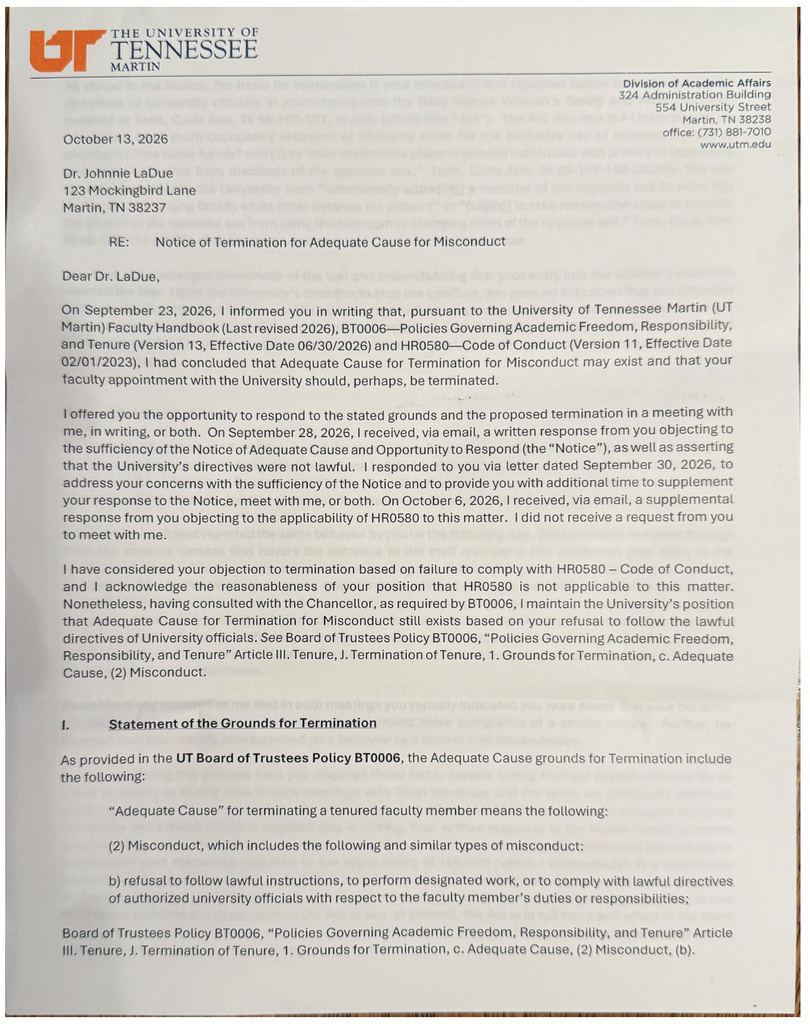
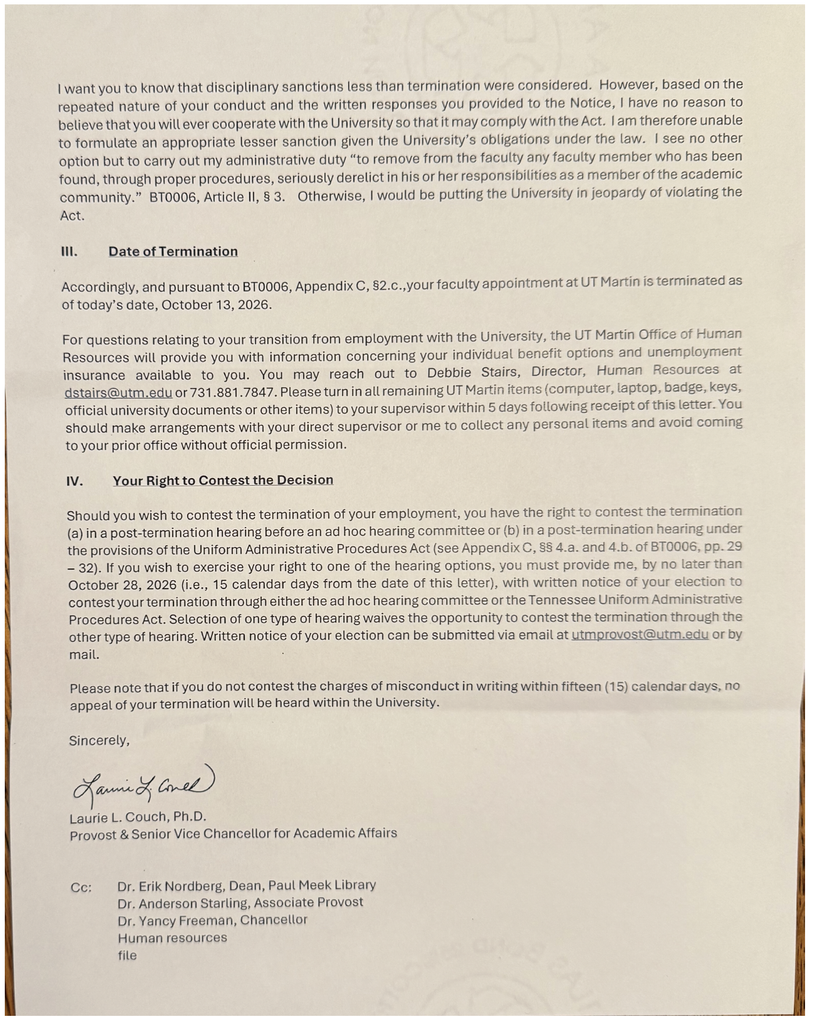
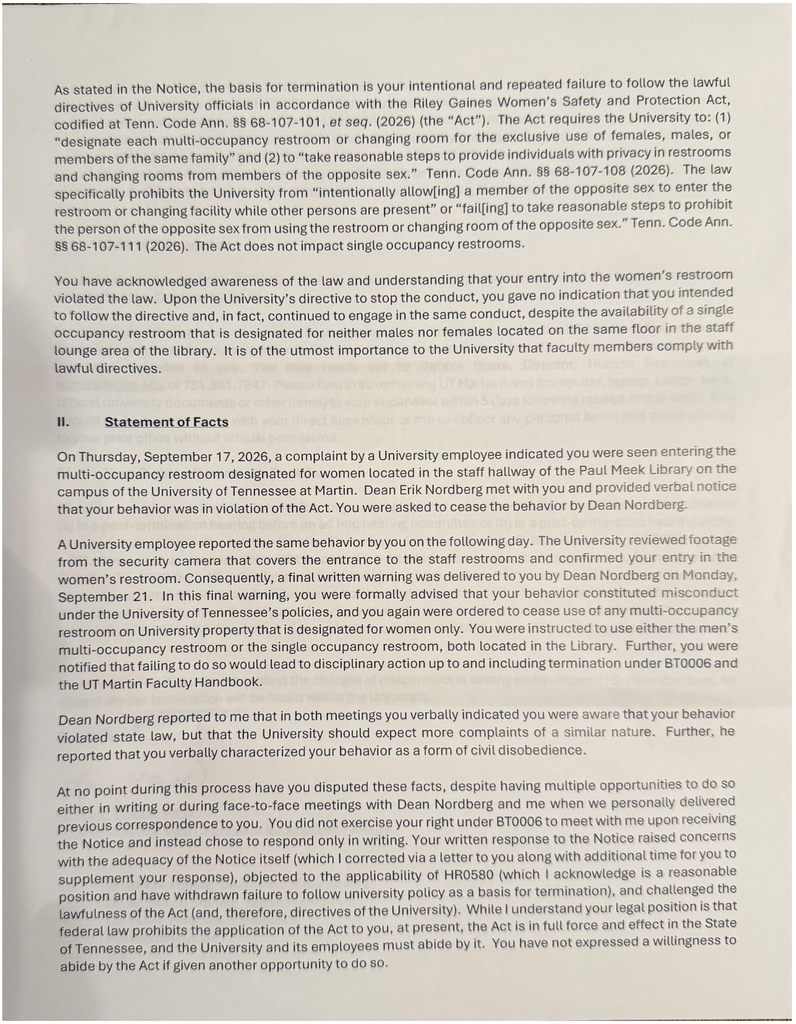
NOTE: These letters were provided by Dr. Johnnie LaDue and used with permission.
That is significant because it demonstrates that termination was not simply an automatic consequence expressly prescribed by the Riley Gaines Act.
University administrators made a disciplinary determination.
Whether they exercised that discretion lawfully is a separate question.
LaDue said the alternatives presented to her concerning restroom use were limited to the men’s restroom or a single-occupancy facility.
She said no other resolution was offered.
The university has not provided Focus with a substantive explanation of why termination was considered necessary rather than another disciplinary measure.
Nor has it explained whether it evaluated additional arrangements or accommodations.
The decision raises questions about proportionality, the scope of university authority and how institutions should respond when employees assert that compliance with a directive would violate their federal rights.
The federal protections at issue
Three areas of federal law are central to the arguments raised during LaDue’s termination process.
Title VII and transgender employees
Title VII of the Civil Rights Act of 1964 prohibits employment discrimination because of sex.
In the 2020 decision Bostock v. Clayton County, the U.S. Supreme Court held that firing an employee merely for being gay or transgender violates Title VII.
That decision established an important employment protection for transgender workers.
However, the Court expressly did not decide every question involving sex-separated restrooms, locker rooms and similar facilities.
That limitation matters here.
LaDue’s case involves not only her transgender identity but also a specific employment directive concerning restroom use.
Whether the university’s conduct violated Title VII would require legal analysis of the facts, applicable precedent and the relationship between the directive and the adverse employment action.
Title VII also prohibits retaliation against employees for certain protected opposition to discriminatory employment practices.
LaDue raised discrimination concerns in writing before the university terminated her.
The university’s termination correspondence reportedly considered those written responses when evaluating disciplinary sanctions.
That sequence may become relevant to a retaliation claim, but the existence of protected activity, the employer’s reasons and any unlawful causal connection would need to be established.
Equal protection
The Fourteenth Amendment’s Equal Protection Clause limits discriminatory action by state governments.
UT Martin is a public university, making constitutional restrictions on state action relevant to its employment decisions.
LaDue argued that enforcing the restroom restrictions against her violated equal protection.
The applicable level of judicial scrutiny and whether the university’s actions satisfy constitutional requirements would be questions for a court.
First Amendment protections
LaDue also asserted First Amendment protections in her written responses.
Public employees have certain constitutional protections for expression, particularly when speaking as citizens on matters of public concern.
Those protections are not unlimited, and their application depends on the nature of the expression, the employee’s role and the government’s interests as an employer.
Whether LaDue’s restroom use or her written objections qualify for particular First Amendment protections remains a contested legal question.
The constitutional and employment claims should not be treated as established violations simply because LaDue raised them.
They do, however, identify the legal questions that could shape future proceedings.
When state and federal law conflict
Tennessee can establish requirements for its public institutions, but state laws do not override applicable federal constitutional protections or federal statutes.
If a state requirement conflicts with controlling federal law, federal law governs.
The difficult question is whether that conflict exists in the specific circumstances of LaDue’s case.
The university’s stated position was that its directives implemented Tennessee law.
LaDue’s position was that complying with those directives would violate her federal rights.
Those positions cannot be resolved simply by pointing to the existence of the state statute.
A court would need to determine what the law requires, whether the university’s response was legally permissible and whether federal protections prohibit the employment action taken against LaDue.
Did her objections become part of the reason for firing her?
One of the most consequential passages in the termination correspondence concerns LaDue’s written responses.
According to the account of the correspondence provided to Focus, the university stated that it considered lesser sanctions but rejected them based in part on the written responses she submitted.
Those responses challenged the legality of the university’s directives.
This creates a question that may prove important in federal litigation.
Was the university treating LaDue’s statements as evidence that she intended to continue refusing its instructions?
Or was it penalizing her for asserting legal rights and objecting to what she believed was discrimination?
The distinction matters.
An employer may consider whether an employee intends to comply with lawful workplace instructions. But federal law also protects certain employee objections to discriminatory practices.
Determining whether unlawful retaliation occurred would require examination of the actual correspondence, the university’s reasoning and applicable legal standards.
Focus has asked the university for clarification concerning the basis for its decision. At the time of this publication, they have declined to answer.
Changes to faculty disciplinary procedures
LaDue’s termination occurred during a year when the University of Tennessee System revised its faculty disciplinary procedures.
On June 30, 2026, the system’s revised BT0006 policy governing academic freedom, responsibility and tenure took effect.
The changes followed state legislation addressing faculty misconduct and disciplinary authority.
Reporting by the Knoxville News Sentinel described the revisions as shifting greater authority over faculty discipline toward university administrators and reducing the role of faculty representatives in certain proceedings.
The revised policy establishes procedures for disciplinary action based on misconduct, including notice, an opportunity to respond and options to contest termination.
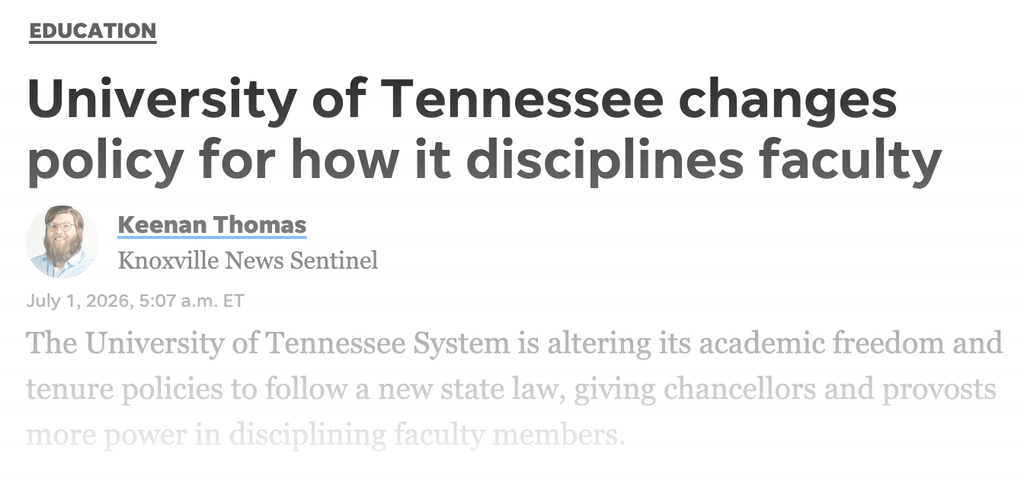
It also distinguishes between different grounds for disciplinary action and provides procedures that vary depending on the allegations.
A source close to the story expressed concern that the changes weakened faculty participation and made it easier for administrators to pursue termination without meaningful peer involvement.
That concern is relevant to the broader discussion about university governance, but it does not establish that the policy changes caused LaDue’s dismissal or that the university failed to follow the procedures applicable to her appointment.
Those questions require separate examination of the exact disciplinary provisions invoked in her case.
Why LaDue did not request a hearing
The October 13 termination letter identified October 28 as the deadline for LaDue to contest the decision through the available university process.
She did not request an appeal or hearing.
LaDue explained that she believed the internal process was unlikely to change the university’s position.
“The appeal process was still an internal university process and it seemed clear they were not budging from their position,” she told Focus.
Her decision not to pursue an internal hearing does not mean she agreed with the university’s decision.
She had already submitted two written responses challenging the grounds for termination.
Nor does the decision, standing alone, determine whether any federal legal claim can proceed. Questions about exhaustion of remedies, filing deadlines and available causes of action depend on the particular claim and governing law.
Information obtained by Focus indicates that federal claims are being prepared on her behalf.
As of this report, Focus has not independently verified that a federal lawsuit has been filed.
What the university has said
Focus contacted university representatives seeking clarification about the application of the Riley Gaines Act, the policies cited during the disciplinary process and the decision to terminate LaDue.
In part 1, we revealed Melissa Tindell, vice president of communications and marketing for the University of Tennessee System, responded:
“The university does not provide comment on personnel matters.”
Focus followed up with additional questions concerning enforcement of restroom restrictions.
The university has not provided a substantive response to those questions in the correspondence available for this report.
Its decision not to discuss an individual personnel matter does not establish wrongdoing. But it leaves several important questions unanswered for the public.
- What specific requirements did administrators believe the Riley Gaines Act imposed on them?
- Did they believe the law required termination?
- What alternatives did they consider, and why were those alternatives rejected?
- How did the university evaluate LaDue’s federal civil rights objections?
- And what procedures were available to a faculty member contesting a directive she believed was discriminatory?
A case with consequences beyond one professor
LaDue’s case sits at the intersection of two developments in Tennessee higher education.
One is the state’s adoption of new restrictions concerning sex-designated facilities.
The other is the University of Tennessee System’s changing approach to faculty discipline and administrative authority.
Together, they raise questions about how public universities respond when employees challenge the legality of instructions they are given.
For transgender faculty members and staff, the consequences may be especially immediate.
A policy concerning restroom access can affect the ordinary conditions under which a person works. A disciplinary decision can determine whether that person remains employed.
For universities, the question is not only how to comply with state law, but how to do so while honoring applicable federal protections.
LaDue’s termination does not settle those questions.
It makes them harder to ignore.
The university has offered its stated grounds for dismissal in writing. LaDue has disputed those grounds. Federal claims are being prepared.
The next stage may determine whether the university’s decision was a lawful exercise of its authority or an unlawful employment action.
For now, one fact is clear: Tennessee’s law did not expressly instruct UT Martin to fire Dr. Johnnie LaDue.
The university made that decision.
Next in the series: The Campus Left Behind. Focus examines how LaDue’s termination affected colleagues, raised questions about faculty governance and left transgender students and employees wondering what protections remain.
Read Part 1 from Nov 20, 2026.
Read Part 3 from Nov 25, 2026.
Editorial note: Historical university posts may use LaDue’s former name or pronouns. Focus uses Dr. Johnnie LaDue and she/her pronouns throughout.

