



Part Three of Three | Focus investigative series by Ray Rico
The Campus She Left Behind
Before UT Martin fired Dr. Johnnie LaDue, the university celebrated her research, teaching and contributions to campus life. Her departure raises questions about what happens when a valued educator becomes the subject of a political and legal dispute.
In August 2025, the University of Tennessee at Martin publicly thanked Dr. Johnnie LaDue for helping lead a summer seminar exploring women’s and gender studies.
In February of that year, another university department praised her for helping students learn how to conduct research and use artificial intelligence responsibly.
Months earlier, the university had highlighted her academic work after a paper she authored received national recognition.
And in April 2025, a campus LGBTQ+ organization honored her for her advocacy and service to students.
These were not descriptions of an educator whose work had gone unnoticed.
They were examples of a university publicly recognizing someone who had become part of its academic and campus community.
On October 13, 2026, that same university fired her.
The reason was not an allegation that she had failed to teach her students, neglected her research or abandoned her professional responsibilities.
According to the university’s termination correspondence, the decision followed her repeated refusal to comply with instructions concerning her use of the women’s restroom under Tennessee’s Riley Gaines Women’s Safety and Protection Act.
LaDue, a transgender woman, maintained that those instructions violated her federal rights.
Her termination has since drawn public criticism from campus labor advocates and left unresolved questions about faculty protections, administrative discretion and the environment for transgender students and employees.
But behind the legal arguments is another story.
It is the story of the work LaDue did, the relationships she built and what happened when her place within the university changed.
More than a librarian
When LaDue joined UT Martin in 2022, she brought years of experience in education, information technology and academic libraries.

Before coming to Tennessee, she spent approximately 15 years at the University of Pittsburgh developing web-based tools for health sciences education.
She earned graduate degrees in library and information science and education.
She also worked as a community college library director before joining UT Martin as an assistant professor and information literacy librarian at the Paul Meek Library.
Her responsibilities extended well beyond helping students locate books.
LaDue taught students how to evaluate information, identify credible sources, understand the influence of media and conduct meaningful research.
In a December 2022 interview with UT Martin’s student newspaper, The Pacer, she described teaching as the part of librarianship she enjoyed most.
The work was particularly relevant in an era of misinformation, political polarization and rapidly changing technology.
LaDue wanted students to question what they encountered online and consider who was producing information, why it was being published and whether the evidence supported the claims.
Those lessons extended into classrooms across campus.
In February 2025, UT Martin’s Department of Mass Media and Strategic Communication recognized her participation in an undergraduate communication research course.
The department described how she helped students understand secondary research and incorporate artificial intelligence into their research process.
The department thanked her and the library staff for sharing their expertise with students.
For LaDue, teaching was not simply a job responsibility. It was an opportunity to help students develop skills they could use long after graduation.
Research that reached beyond campus
LaDue’s academic interests included information literacy, critical education, media ownership and the relationship between knowledge and power.
In 2024, her paper, Information Literacy: Moving Beyond Critical to Revolutionary, received an honorable mention in the Annual Library Juice Paper Contest.

The work had also appeared in the Journal for Critical Education Policy Studies.
UT Martin publicly recognized the achievement in its faculty and staff communications.
Later that year, LaDue participated in the UT Martin Research Series with a public presentation examining corporate ownership of American media.
The December 2024 program, held at the Martin Public Library, explored how media ownership influences the information people encounter and how they understand the world.
It was part of the university’s broader effort to bring academic research into public conversation.
LaDue’s participation reflected a professional commitment to connecting scholarship with everyday concerns.
Her work was not limited to campus classrooms or academic journals.
She also contributed to public discussions about information, education and civic life.
That history matters because it provides context for the university’s relationship with LaDue before the events that led to her termination.
The university had repeatedly presented her as an active and valued member of its academic community.
A place in campus life
LaDue also participated in activities that connected students and faculty beyond their academic responsibilities.
In February 2023, UT Martin’s CommUnity Center publicly thanked her for a presentation about Marsha P. Johnson, the Black transgender activist whose life and work helped shape LGBTQ+ history.
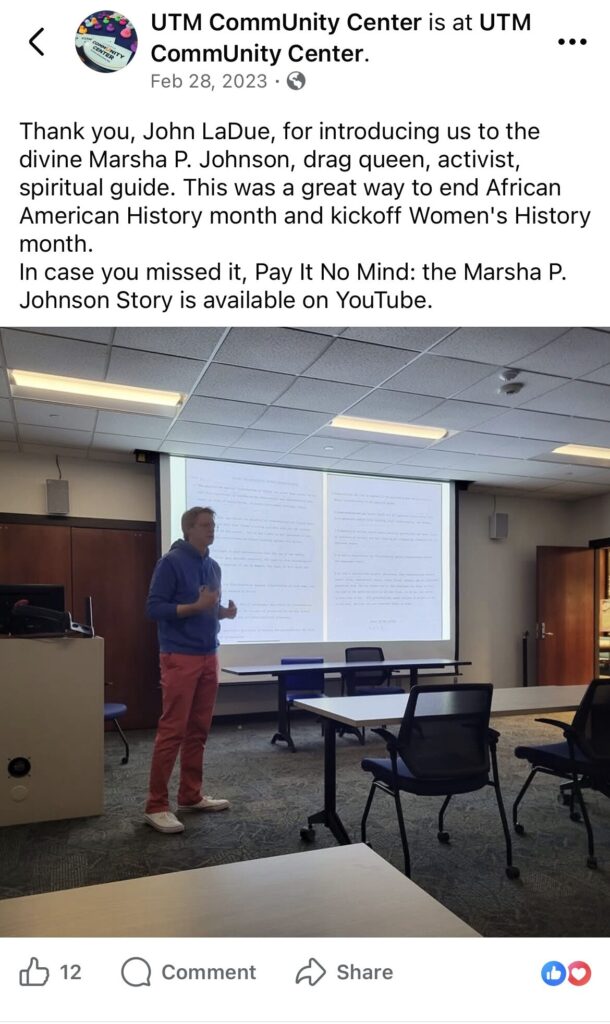
The event connected Black History Month with the beginning of Women’s History Month.
In April 2025, LaDue received the Elliot McKeel Advocate and Ally Award, presented through the campus LGBTQ+ community.
The recognition highlighted her willingness to volunteer, participate in student events and support campus activities.
It was an acknowledgment of the time she spent showing up for students outside her formal teaching duties.
In August 2025, she helped lead sessions at UT Martin’s Women and Gender Studies Summer Seminar, which included discussions about LGBTQ+ policy, women’s rhetoric and gender in dance.
And in November 2025, the campus CommUnity Center thanked her for speaking at a Transgender Day of Remembrance gathering.
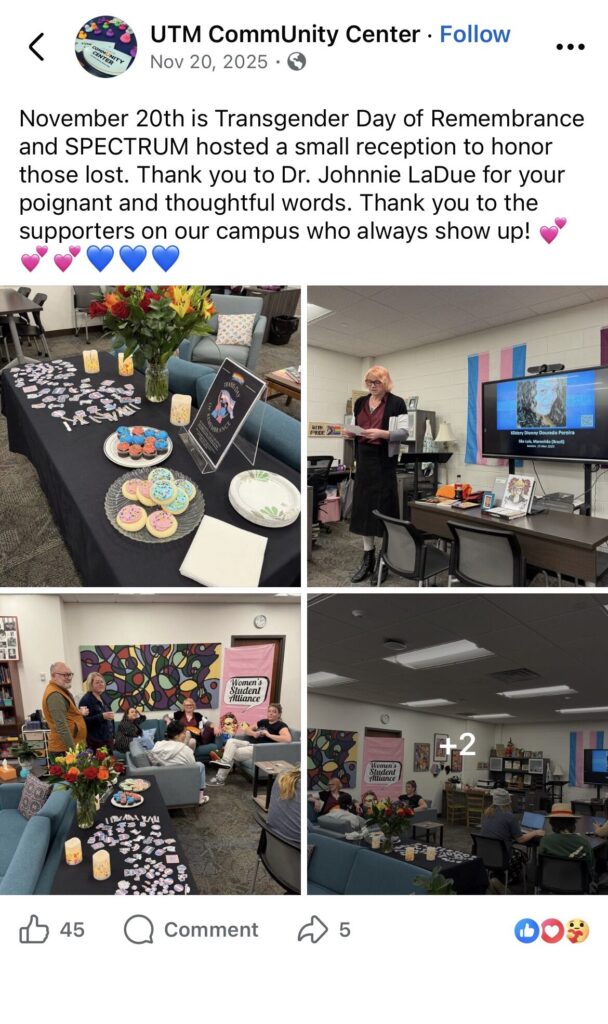
These activities illustrate a dimension of LaDue’s work that cannot be measured through course evaluations or research publications alone.
She helped create opportunities for students and colleagues to discuss identity, history, inclusion and difficult social issues.
Those opportunities can be especially meaningful on campuses where LGBTQ+ students have limited access to visible community support.
They also make the circumstances of her departure more striking.
A university that had publicly recognized her contributions to campus life later determined that her refusal to follow restroom directives warranted dismissal.
When the atmosphere changed
LaDue said many of her colleagues supported her when she began living openly as a woman on campus.
She described coworkers who treated her with respect and continued to support her professional work.
According to LaDue, colleagues selected her to represent the library on a search committee for the university’s next provost after she had come out.
She also said she received a positive mid-tenure review.
LaDue said the library dean checked on her well-being and asked whether she was experiencing harassment.
She recalled that she generally was not subjected to direct harassment from colleagues.
But she also began noticing changes.
She said she appeared less frequently in the library’s social media communications than she had previously.
She also recalled an incident in which a student appeared to record her while she was speaking.
Neither observation, by itself, establishes discrimination or explains the university’s subsequent disciplinary decision.
For LaDue, however, these experiences contributed to a growing awareness that being openly transgender had changed how she moved through the institution.
The more consequential change came in September 2026.
After beginning to use the women’s restroom regularly during the workday, she received complaints, warnings and instructions to use other facilities.
Within days, she was placed on administrative leave.
She never returned to campus.
The people who supported her
LaDue’s dismissal did not go unnoticed among campus workers.
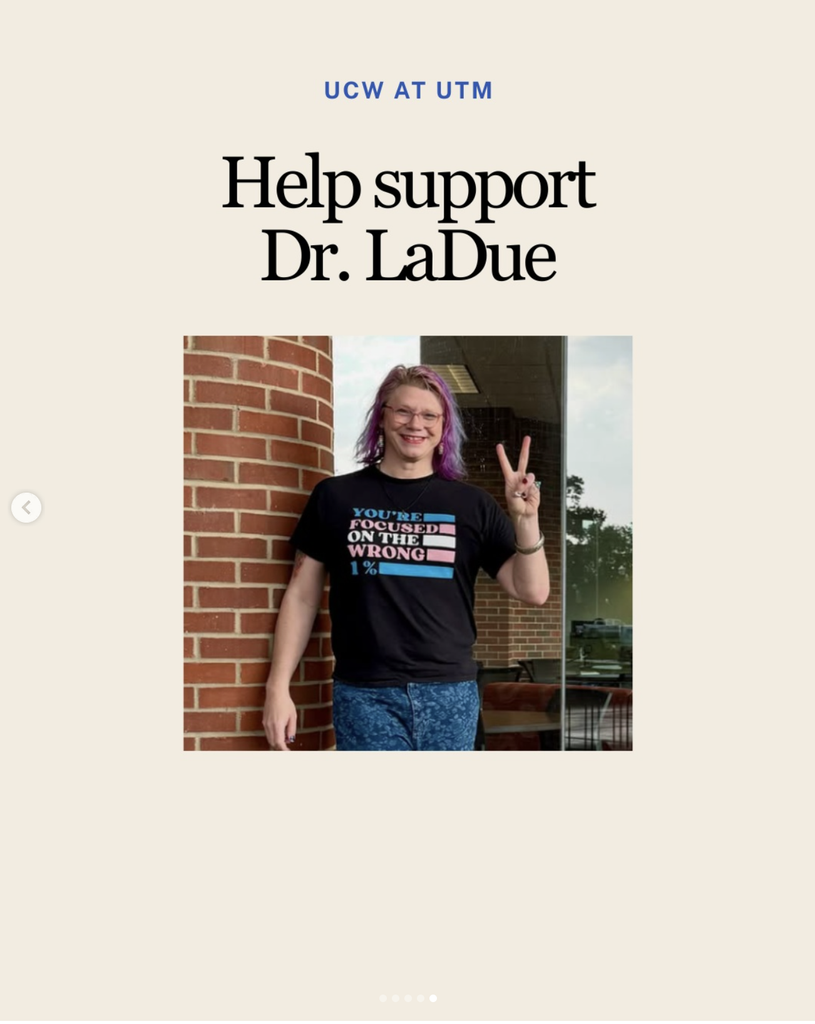
On October 21, Higher Education Labor United published a statement supporting LaDue, sharing a message from her and colleagues associated with United Campus Workers at UT Martin.
The statement criticized the termination and described the disruption to her life after four years at the university.
United Campus Workers is affiliated with the Communications Workers of America and organizes employees across Tennessee’s public higher education institutions.
The organization advocates for workplace protections, employee participation and fair treatment of campus workers.
Its involvement places LaDue’s experience within a larger conversation about the rights of university employees.
The dispute is not only about restroom access.
It is also about the power administrators exercise over faculty members, how employees can challenge directives and what protections exist when a dispute involves civil rights.
Materials shared with Focus by a source close to the story also describe concern about the disciplinary process and its implications for faculty members.
To protect the confidentiality of those communications, Focus is withholding identifying details, including names, correspondence headers and information that could reveal the source.
The materials offer insight into concerns surrounding the case but do not independently establish that the university violated its policies or the law.
Those determinations require examination of the governing procedures and the actions taken in LaDue’s particular case.
What faculty protections mean now
LaDue’s termination occurred during a period of significant changes to faculty disciplinary rules within the University of Tennessee System.
Revisions to the system’s academic freedom, responsibility and tenure policy took effect in 2026.
The changes addressed how allegations of faculty misconduct are handled, the authority of senior administrators and the procedures available to faculty members facing disciplinary action.
Some procedures distinguish between concerns about teaching or research performance and allegations of misconduct.
That distinction matters because faculty participation and review procedures may differ depending on the grounds for discipline.
The policy provides processes for notice and response, as well as avenues to contest certain termination decisions.
But a formal process does not automatically resolve questions about fairness, independence or whether the underlying directive was lawful.
For faculty members, the broader concern is whether they can challenge an administrator’s interpretation of the law without putting their careers at risk.
For university leaders, the question is how to enforce institutional policies while protecting employees’ rights.
And for students, the issue extends to whether faculty members can advocate for marginalized communities without fear that doing so could affect their employment.
LaDue’s case brings these questions into sharp focus.
It does not, on its own, establish that the university’s faculty disciplinary procedures were violated.
It does demonstrate why those procedures deserve public scrutiny.
The faculty perspective Focus sought
Focus requested an interview with a faculty representative to better understand how faculty governance operates at UT Martin and how employees receive guidance when new state laws affect university policies.
The representative declined, explaining that they no longer held the Faculty Senate presidency, were not comfortable speaking on behalf of faculty members and were unavailable for an interview.
That response should not be interpreted as support for or opposition to LaDue’s termination.
It also means Focus has not obtained an official Faculty Senate position on the case.
Questions remain about whether the Faculty Senate reviewed changes in restroom access policies, how faculty members were informed of the new requirements and whether the Senate has discussed the implications of LaDue’s termination.
The absence of an official faculty response leaves an important part of the university’s governance process unexplained.
What happens when a campus loses an educator?
An employee’s departure can affect an institution in ways that do not appear in personnel records.
Students lose access to a particular teacher.
Colleagues lose a collaborator.
Academic programs lose experience and institutional knowledge.
Community initiatives lose someone who helped organize, teach or participate.
The full effect of LaDue’s departure on UT Martin’s programs and students has not been independently measured.
But the university’s own public records show that her work crossed multiple parts of campus life.
She taught information literacy.
She contributed to research.
She supported student organizations.
She participated in academic seminars.
She helped students understand media, history and the world around them.
Her contributions were not confined to one department.
For students who saw her as a visible transgender faculty member, her departure may carry an additional significance.
Representation in higher education is not simply a matter of who appears in a university brochure.
It is also about who can work, teach and participate openly in campus life.
LaDue’s termination raises questions about whether transgender educators can continue to do those things under Tennessee’s current legal and political conditions.
That concern is broader than any single institution.
Starting over in Michigan

After her termination, LaDue left Tennessee.
She relocated with her dogs to a short-term rental near Detroit, choosing the area partly because it was more affordable than other cities in states she considered safer for transgender people.
She told Focus that the move brought relief but also considerable uncertainty.
Her professional field is specialized, and opportunities are limited.
She is uncertain whether she wants to return to higher education after investing so much of herself in her work.
“Personally and professionally, I find myself at a crossroads,” she told Focus.
The financial consequences have been substantial.
LaDue said she was attempting to sell her Tennessee home and planned to access retirement savings to support herself during the transition.
She also faced the loss of employer-sponsored health insurance at the end of November unless she secured another position or obtained alternative coverage.
A GoFundMe campaign exists to help with relocation and living expenses.
For LaDue, the uncertainty extends beyond employment.
It involves rebuilding a home, finding community and deciding what kind of professional future she wants.
She said she was encouraged by the support of many former colleagues, although she was also disappointed by the silence of others.
The experience has changed her relationship with the profession she once embraced.
Her years at UT Martin were defined by teaching, research and engagement with students.
Now, she is deciding whether she wants to return to that work at all.
A larger question for Tennessee
The consequences of LaDue’s termination reach beyond one professor’s career.
Tennessee’s public universities employ thousands of people who must navigate state law, university policy and federal employment protections.
For transgender employees, ordinary workplace decisions can carry extraordinary consequences.
A trip to the restroom became the beginning of a disciplinary process that ended LaDue’s employment.
The university maintained that she failed to follow directives connected to state law.
LaDue maintained that those directives violated her rights.
Her case raises questions about what happens when a public university’s interpretation of state law conflicts with an employee’s understanding of federal protections.
It also raises questions about the role of faculty governance, the discretion available to administrators and the consequences of challenging institutional authority.

Those questions remain unresolved.
Information obtained by Focus indicates that federal claims are being prepared on LaDue’s behalf.
Any legal proceeding would provide another opportunity to examine the university’s reasoning and the protections LaDue asserts.
But legal proceedings cannot fully answer what the university and its community have lost.
The university’s own publications once documented an educator helping students evaluate information, examine power and question what they were told.
Those lessons were central to LaDue’s work.
They are also relevant to the questions her departure leaves behind.
What does a university owe its employees when state law changes?
Who decides whether an employee’s objection is protected or punishable?
And what does it mean for a campus to celebrate inclusion while terminating a transgender professor over the restroom she used?
For Johnnie LaDue, those questions are no longer theoretical.
They have already changed her life.
This concludes Focus’s three-part investigation into the termination of Dr. Johnnie LaDue. Focus will continue reporting on developments involving the university, Tennessee law and any subsequent legal proceedings.
Sources and reporting notes
This story draws on interviews and written responses from Dr. Johnnie LaDue, university disciplinary correspondence reviewed for this investigation, public university records, student journalism, official policy documents, and communications from university representatives.
Additional materials were provided by a source close to the story. Identifying information has been withheld to protect confidentiality. Those materials are not presented as independent proof of disputed legal conclusions.
Editorial note: Historical university posts may use LaDue’s former name or pronouns. Focus uses Dr. Johnnie LaDue and she/her pronouns throughout.

